
Some of the most valuable moments at a conference don’t happen during the presentations. They happen in the corridor afterwards, when someone walks up to your poster and asks the question you’ve been wrestling with for months.
OUTFOX had plenty of both. The European Fuel Cell Forum (EFCF) 2026 took place in Lucerne, Switzerland, from 30 June to 3 July — one of the most established gatherings in the solid oxide community — and three members of the OUTFOX consortium presented the project’s work to an audience of researchers, engineers, and industry professionals from across the field.
Scaling cells to 900 cm² — and being honest about what’s left
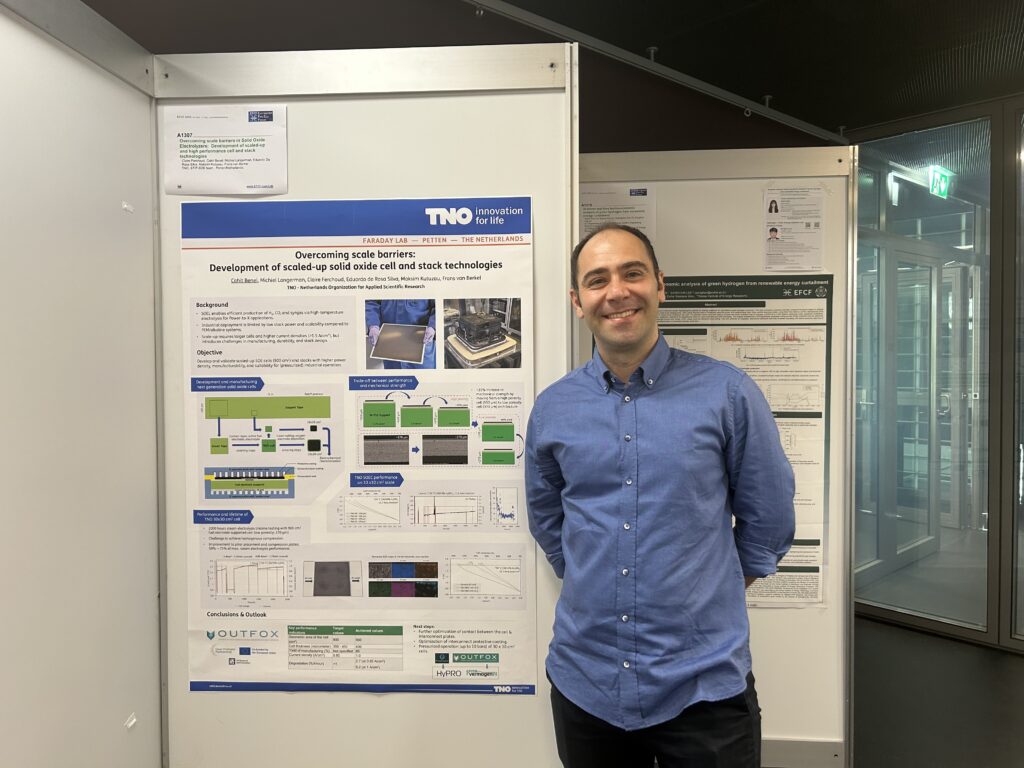
Cahit Benel, project coordinator at TNO, presented a poster on one of the central technical achievements of OUTFOX: the development of scaled-up solid oxide cells and stack technologies.
The poster, Overcoming Scale Barriers: Development of Scaled-Up Solid Oxide Cell and Stack Technologies, brought together the work of the TNO team — Cahit Benel, Michiel Langerman, Claire Ferchaud, Eduardo da Rosa Silva, Maksim Kutuzau, and Frans van Berkel — on taking cells from laboratory formats to the 900 cm² scale the project set out to achieve.
The results speak for themselves. Against the project’s key performance targets, the achieved values tell a clear story: geometric cell area of 900 cm² (target: 900), cell thickness of 430 micrometres, manufacturing yield of 85%, and current density of 1.0 A/cm² — exceeding the project’s own 0.85 A/cm² target.
Behind those numbers sits a materials engineering story that the poster laid out in detail: the trade-off between performance and mechanical strength. Moving from a high-porosity cell architecture (550 µm) to a low-porosity design (370 µm) delivered a 25% increase in mechanical strength — the change that made manufacturing yields above 80% possible at the 30×30 cm format. Lifetime testing has accumulated 2,000 hours of steam electrolysis operation with the 900 cm² cells.
Just as notable was what the poster didn’t claim. Degradation at high current density remains above the project’s long-term target, and the next steps were stated plainly: further optimisation of the contact between cell and interconnect plates, improved interconnect protective coatings, and pressurised operation of the 30×30 cm cells up to 10 bar. That kind of openness about remaining work is what makes results credible — and it reflects how OUTFOX has communicated throughout.
The economics of scale-up: where the costs actually are
Marco Ficili from Politecnico di Milano presented the techno-economic side of the project with a poster on modular SOE systems and the scale-up effects on Capex and hydrogen cost, co-authored with Stefano Campanari and Paolo Colbertaldo.
The analysis models a modular SOE unit of approximately 11 MW, built up from hot-box modules and balance-of-plant components, and asks two questions that matter enormously for anyone planning real deployments: which components actually drive the capital cost, and what happens to the levelised cost of hydrogen as systems scale.
Several findings stood out.
Electricity cost is the dominant driver of hydrogen cost in all scenarios modelled — capital expenditure reaches at most around 40% of LCOH, and only at low electricity prices combined with high capacity factors. Reducing the electricity price from 100 to 40 €/MWh cuts the levelised cost of hydrogen by up to 52%. However efficient the system, the price of power remains the biggest lever.
On the system side, the rectifier and hydrogen compressor together account for a substantial share of uninstalled Capex — making them primary targets for cost reduction strategy. The analysis quantified two scale-up options: sharing a hydrogen compressor across multiple SOE units cuts Capex by roughly a third, and scaling the hot-box from 1 to 5 MW reduces uninstalled Capex by around 46% — approaching the cost targets set for the technology.
Internal heat integration, recovering heat from both air and fuel sides, reduces the steam generation demand meaningfully — though it covers only part of the total evaporation load, which is why access to industrial waste heat remains such an important factor in siting decisions.
The conclusion echoes what OUTFOX modelling has shown throughout: the pathway to competitive hydrogen costs exists, with scale-up options yielding LCOH reductions of up to 24% — but it depends on electricity price, capacity factor, and manufacturing scale moving together.
Systems, scale-up, and the conference floor
Tuomas Hakala, co-founder and CTO of Convion, completed the OUTFOX trio with a poster presentation bringing the systems perspective — how solid oxide electrolysis moves from stacks to complete industrial systems, the theme Convion is currently putting into practice as it prepares the project’s 80 kW demonstration in Finland.
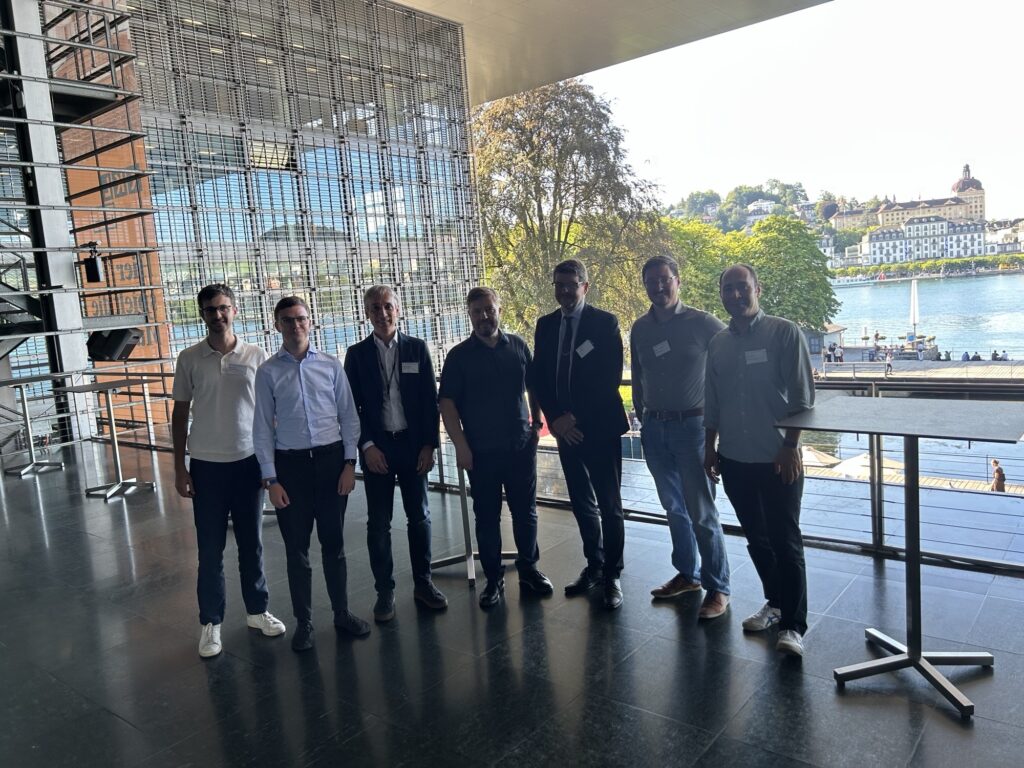
Beyond the posters, the week offered what conferences do best: unhurried conversations with people working on the same problems from different angles. The solid oxide community is not enormous, and EFCF is one of the few places where cell developers, stack manufacturers, system integrators, and modellers from across Europe and beyond are in the same building for four days. Those conversations — over coffee, at posters, and during a memorable evening boat trip on Lake Lucerne — are where collaborations start.
What’s next
The results presented in Lucerne now feed directly into the final phase of OUTFOX. The 80 kW system demonstration is taking physical shape at VTT’s Bioruukki site, where the water treatment and steam generation container was delivered earlier this year. The operational data from that campaign — combined with the cell results and techno-economic analysis presented at EFCF — will come together in the project’s deployment roadmap.
To follow the project through its final year, subscribe to the OUTFOX newsletter or follow us on LinkedIn.