
Some project milestones arrive as data. This one arrived on a truck.
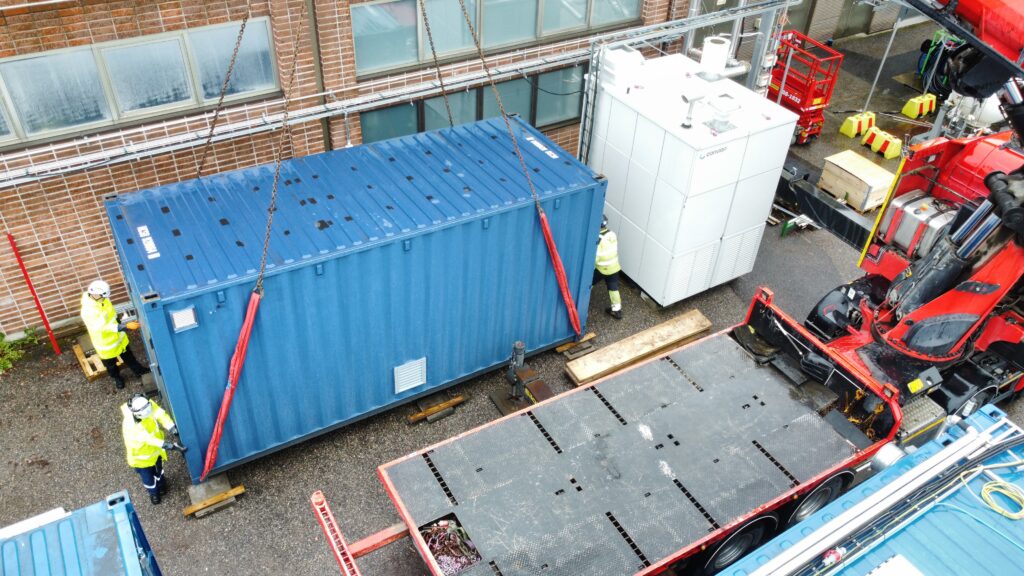
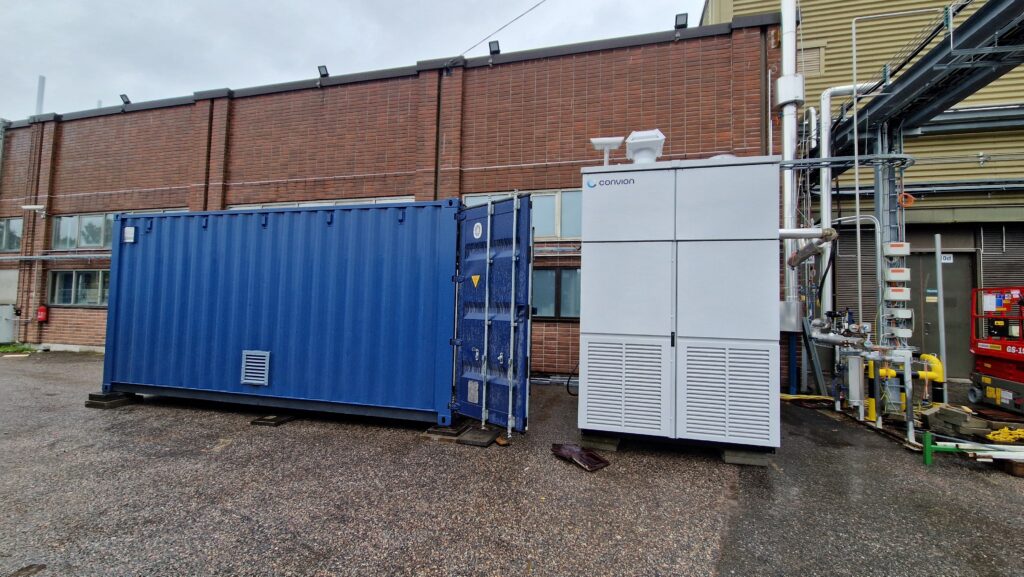
In June, the water treatment and steam generating container for the OUTFOX 80 kW demonstration was delivered to VTT’s Bioruukki piloting centre in, Finland — craned off a lowboy trailer and set down alongside the Convion system it will soon be connected to.
It is one of those moments that makes a research project feel suddenly concrete. For three years, OUTFOX has been developing cells, validating stacks, and modelling systems. Now the hardware for the project’s most important test is physically standing on site.
What was delivered — and why it matters
Solid oxide electrolysis splits steam, not liquid water. That means every SOEL system needs a reliable supply of high-quality steam before a single ampere flows through the stack — and producing that steam requires treated water, controlled generation, and careful integration with the rest of the system.
That is the job of the container that arrived this week. It houses the water treatment and steam generation equipment that will feed the demonstration system throughout the test campaign — a self-contained unit, delivered as a complete module and positioned directly alongside the Convion system at Bioruukki.
The modular, containerised approach is not incidental. It reflects the same design philosophy that runs through the whole OUTFOX system concept: factory-built, transportable units that can be delivered, positioned, and connected on site rather than constructed from scratch — the approach that will matter enormously when systems scale from demonstration size to industrial deployment.
What happens next
With the container in place, the work moves to integration — and this phase is deliberately unhurried.
The immediate tasks are connecting the container into the system and ensuring that steam can be safely discharged in the event of any malfunction. Over-pressure protection is exactly the kind of engineering detail that rarely features in project updates but sits at the heart of responsible system design: before anything operates, every failure scenario needs a safe outcome.
Beyond the physical connections, the team will carry out a full interface HAZOP — a hazard and operability study — together with VTT, reviewing the safety of the integration as a whole before the system gets the go-ahead. A HAZOP systematically examines every interface between the new equipment and the existing installation, asking what could deviate from the design intent and what the consequences would be. It is a standard of rigour that industrial deployment demands, applied here at demonstration scale.
The aim is to move through this work efficiently and make good use of the summer months — even with the holiday season in the mix.
Where this fits in the bigger picture
The 80 kW demonstration is the culmination of the OUTFOX project — the point where three years of cell development, stack validation, and system design come together in one operating installation.
The campaign will run for more than 4,000 hours, covering both steady-state operation and the kind of intermittent load profiles that real renewable energy applications produce. The data it generates — on performance, degradation, system behaviour, and operating limits — does not currently exist for solid oxide electrolysis at this scale. Producing it is one of the most valuable things the project can do for the wider hydrogen community, because operational track records are precisely what electrolyser manufacturers, project developers, and lenders need before committing to the technology at industrial scale.
Every delivery, connection, and safety review from here on is a step toward that data.
We will continue to share progress as the integration work advances. To follow the demonstration as it happens, subscribe to the OUTFOX newsletter or follow the project on LinkedIn.